AGWPE
AGW Packet Engine protocol interface for legacy software
The AGWPE (AGW Packet Engine) interface provides compatibility with Windows packet radio software that speaks the AGW protocol. This is a single-instance TCP server that supports multiple simultaneous clients and up to four radio ports.
Settings
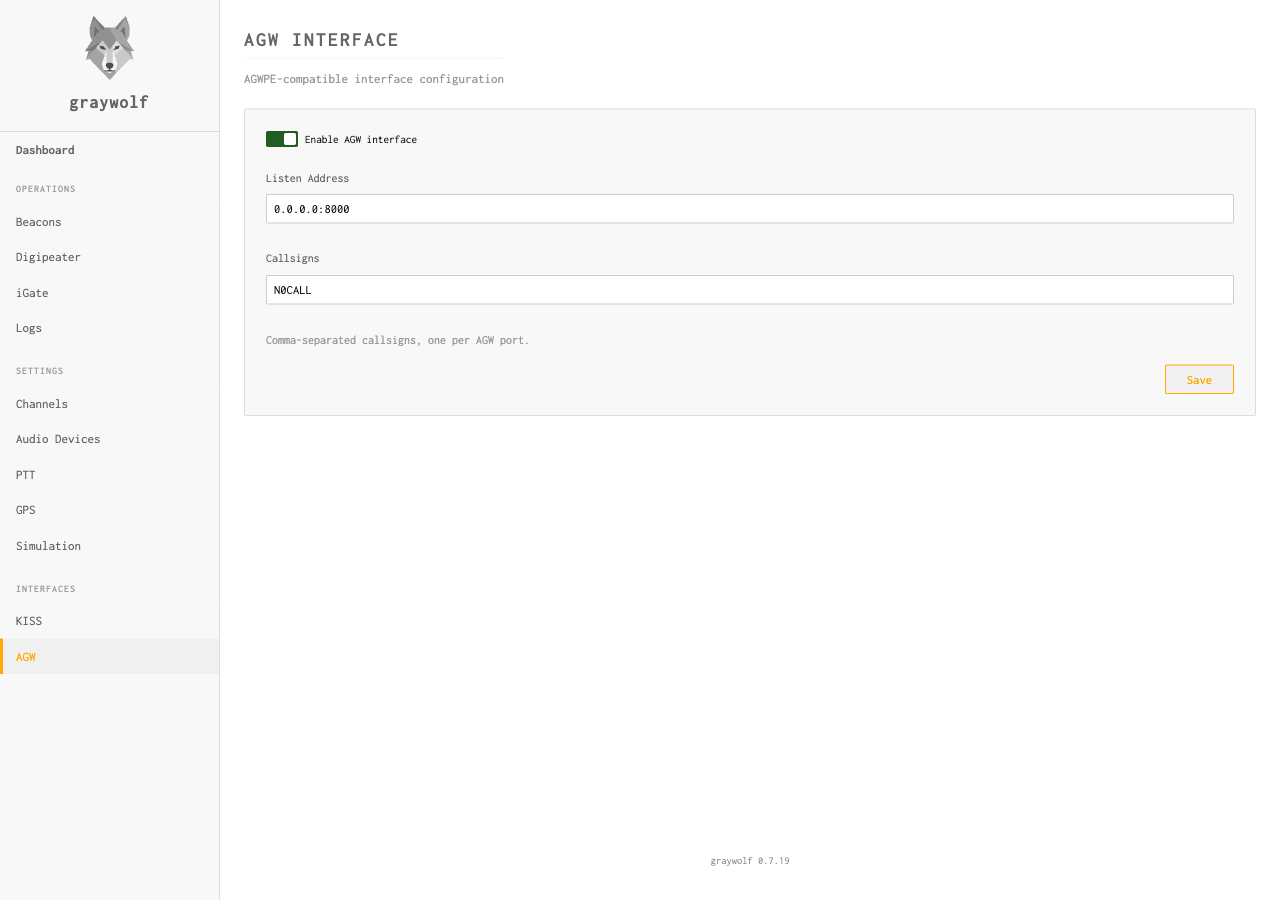
| Field | Default | Description |
|---|---|---|
enabled |
false |
Enable the AGWPE listener |
listen_addr |
0.0.0.0:8000 |
TCP listen address |
callsigns |
— | Comma-separated callsigns, one per AGW port (max 4) |
Port Mapping
AGWPE supports up to four radio ports (numbered 0–3). Each port
is mapped to a callsign specified in the callsigns field.
The order determines the port number:
callsigns: "N0CALL,N0CALL-5,N0CALL-10"
# Port 0 → N0CALL
# Port 1 → N0CALL-5
# Port 2 → N0CALL-10
Supported Frame Types
Graywolf implements the AGWPE protocol subset needed for packet radio operations:
- Monitor frames — receive decoded AX.25 packets
- Unproto frames — transmit UI (unnumbered information) packets
- Raw frames — send and receive raw AX.25 data
- Connected-mode sessions — call out to a remote station, with or without digipeaters, and exchange data over the link. Clients such as Paracon, AGWTerm and EasyTerm can use graywolf as their TNC for BBS and node access.
Connected Mode
Connected mode is outbound only. Your AGWPE client can raise a link to a remote station, but an incoming call from the air is not handed to AGWPE clients.
The channel your AGWPE port maps to must have its mode set to Packet or APRS + Packet on the Channels page. Channels are APRS-only by default, and an APRS-only channel refuses connected-mode calls. Your client will report the attempt as disconnected with the reason.
Port 8000 is the conventional AGWPE port. Most AGWPE-compatible software will default to this port.